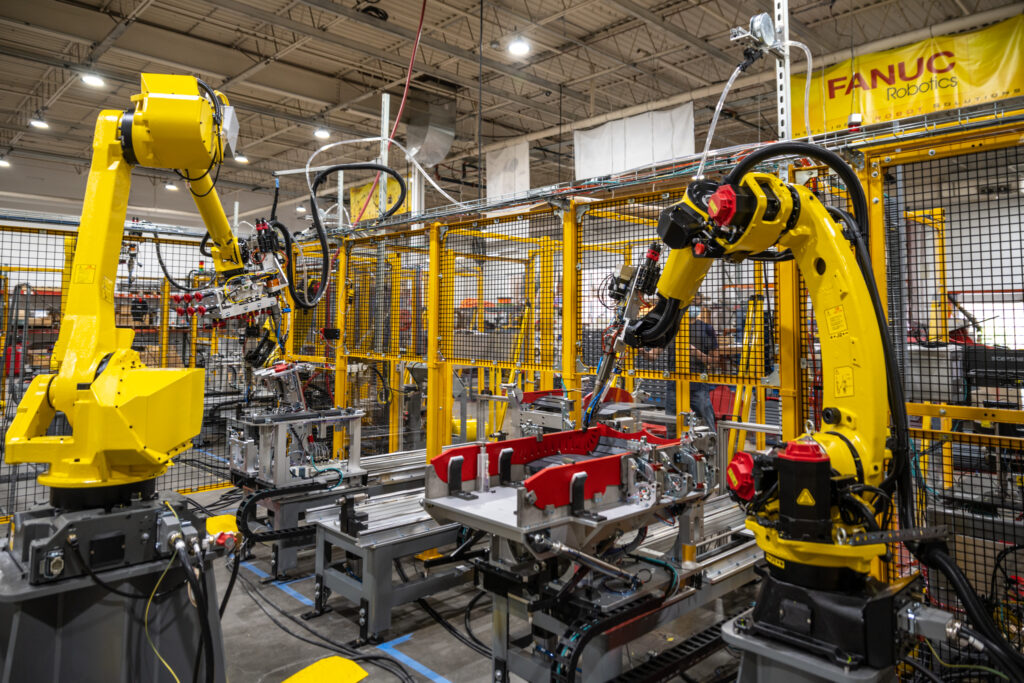
In contemporary manufacturing, the push to automate processes is often driven by a need to increase precision, speed, and reliability. The processes don’t have to be particularly complex to make automation a challenge. Consider screw driving, for example.
One of the most common yet complex tasks to automate is the simple act of fastening components together with screws. Doing this process manually is imprecise, slow and unreliable. Which is one of the primary reasons so many manufacturers are searching for automated screwing solutions, and how to integrate these robots into existing processes.
Integrating an automated screwdriving system into your production line is a significant step toward modernizing your operations. Here are some tips on how to make that happen.
The Primary Drivers for Automation
There are many factors that motivate manufacturers to automate, ranging from labor availability to limitations of manual labor, to achieving more reliability, obtaining more data and process controls, or even seeking higher throughput. Manual screwdriving is a tedious, repetitive, time-consuming process. In assemblies that require a high fastener count, it is remarkably easy for human operators to miss fasteners. Other potential errors exist as well, such as cross threading, or incorrect installation (i.e. not fully seated). These errors lead to quality control issues and product failures in the field.
Beyond human error, automation is driven by the need for comprehensive data. Many industries require torque feedback, install depth, or even number of turns for every fastener installed. While it is possible to collect this data in manual operations, it is significantly more consistent, efficient, and reliable to do so through an automated system.
Finally, throughput can also be a major consideration. Not only can a robot drive screws faster than a human can, but they can also run continuously while making fewer errors. These factors, combined with more-consistent processing and better data collection for statistical process controls, are essential in high-volume manufacturing.
Diverse Industry Applications
The need for automated screwdriving spans across multiple sectors, each with its own specific goals.
- Aerospace: In this sector, the focus is less on speed and more on meticulous data collection and record-keeping.
- Safety-Critical Components: For products like natural gas regulator valves, manufacturers must prove that 100% of the screws are present and driven according to the required process controls. These systems often use cameras to verify presence, installation depth, and other quality control metrics.
- Consumer Goods: For high-volume items like outdoor furniture and baby-changing tables, the primary goals are process consistency, labor reduction, and increased throughput. For example, a single Adirondack chair might require 58 screws. Automating this process replaces a massive amount of manual labor while improving overall product quality.
Technical Considerations for Successful Integration
Choosing the right technical approach is vital for a successful integration. One of the first decisions is the screw delivery method. Blow-feeding screws directly to the driver allows for very high-speed operations, but comes with a cost premium and can be limited by fastener geometry. Whereas pick-and-place methods—where the robot picks a screw from a feeder before driving it—are better suited for lower-volume, applications where speed and throughput are not primary considerations.
The fasteners used also dictate the strategy. Self-tapping screws are common in plastic consumer goods because they cut their own threads, reducing the risk of cross-threading. However, they must be controlled while driving to avoid driving in the wrong direction.
Machine screws present a higher risk of cross-threading. To combat this, experienced integrators use tricks of the trade, such as running the driver backward for a full turn to properly set the screw into the threads before driving it forward. Additionally, maintaining the correct approach angle between the driver and the assembly is vital to prevent assembly failure.
Advanced Integration: Vision and Floor Space
Successful integration also requires looking at the broader manufacturing environment. Vision systems are often necessary when dealing with parts that have high tolerance variation. For instance, in plastic baby-changing tables, the hole positions may vary by more than the diameter of a screw due to process tolerances, thermal expansion, variations in material lots, etc. In these cases, a vision system locates each hole before the robot drives the screw, ensuring accuracy despite part inconsistency.
Integrators must also consider the physical footprint available on the factory floor and how the system fits into the existing manufacturing flow. Often, once a part is securely located for screwdriving, there is an opportunity for scope expansion. If a manual process occurs immediately after the screwdriving station, for example, it may be possible to automate that task as well for little additional cost, further increasing the value of the automation cell.
Addressing Common Misconceptions
A common misconception among manufacturers is lights-out automation—a plug-and-play system that requires zero human intervention. In reality, these machines still require skilled operators to help the system recover when it encounters a problem. Just do the math to see why.
If a product has 56 screws and the machine has a 99% success rate, it will technically fail to complete a product every two units. Even at 99.5% accuracy, the cumulative probability of an error in a multi-step process means an operator must be nearby to manage recoveries and keep the system operating.
Why Partner with an Experienced Integrator?
The difference between a successful automated screwdriving integration and a failed project often comes down to the experience of the integrator. The automation industry has many small companies that bid low to build their resumes, but they often lack the deep tribal knowledge required to successfully implement complex automated fastening systems.
An experienced team has already gone through the lessons-learned phase on previous projects. Engineering decisions are made based on known past successes rather than guesswork. An experienced integrator quickly addresses technical hurdles with known confident execution, generally outweighing any benefit provided by a less-experienced partner.
Conclusion
Automated screwdriving is a powerful tool for improving throughput, quality, and data reliability. By moving away from manual processes, manufacturers ensure that every screw is accounted for and every assembly meets strict safety and quality standards. But success requires more than just a robot. It requires a custom-engineered solution that accounts for material intricacies, part variation, and realistic operational expectations. Partnering with an experienced integrator ensures that these complexities are managed, resulting in a robust system that delivers a high return on investment.
If you need expert help optimizing production with automated screwdriving integration, let’s talk.
FAQs
Q: What is automated screwdriving?
Automated screwdriving is the use of programmed equipment to feed, place, and tighten screws with controlled torque and sequence. It is often used to improve assembly speed, repeatability, and documentation compared with manual fastening.
Q: Why do manufacturers automate screwdriving?
Manufacturers automate screwdriving to reduce labor dependency, improve fastening consistency, lower rework, and capture process data such as torque results. It is especially useful where fastener quality is critical or screw counts are high.
Q: What should be evaluated before implementing automated screwdriving?
Important factors include screw size and type, part presentation, access to the fastening point, torque requirements, cycle-time targets, and whether the process needs traceability. These details determine feeder design, tooling, and overall cell feasibility.