In the rapidly evolving industrial landscape, efficiency and cost-effectiveness are top priorities. One of the most significant advancements in recent years has been the adoption of automated material handling solutions. These technologies are revolutionizing manufacturing and logistics by reducing manual labor, increasing efficiency, and optimizing workflow management.
Advantages of Automated Material Handling
Implementing automation in material handling offers numerous benefits that enhance productivity and streamline operations:
1. Reduced Labor Costs
Automation minimizes the reliance on manual labor, significantly reducing operational expenses. With automated systems handling repetitive and physically demanding tasks, businesses can allocate human resources to more complex, value-added activities.
2. Improved Safety
Workplace injuries due to heavy lifting, repetitive motion, or human error are common in material handling environments. By reducing human involvement in these tasks, automation improves workplace safety and ensures compliance with industry safety standards.
3. Enhanced Speed & Accuracy
Automated systems ensure precise handling of materials, reducing errors, minimizing waste, and improving overall efficiency. Robotics, AI-driven inventory management, and advanced sorting technologies enhance accuracy in manufacturing and warehouse operations.
4. Scalability
As production demands evolve, automated solutions provide the flexibility to scale operations without extensive workforce adjustments. Whether expanding output or adapting to seasonal demand fluctuations, automation offers seamless scalability.
5. Optimized Space Utilization
Advanced storage and retrieval systems maximize warehouse efficiency, reducing the footprint required for inventory management. Automated vertical storage and robotic systems make it easier to store and retrieve materials in compact spaces.
Common Solutions in Automated Material Handling
The integration of automation in material handling is achieved through various technologies, each designed to enhance efficiency and streamline operations:
- Conveyor Systems – Move materials seamlessly across facilities, ensuring smooth workflow transitions.
- Automated Guided Vehicles (AGVs) – Transport goods autonomously, reducing dependency on manual labor.
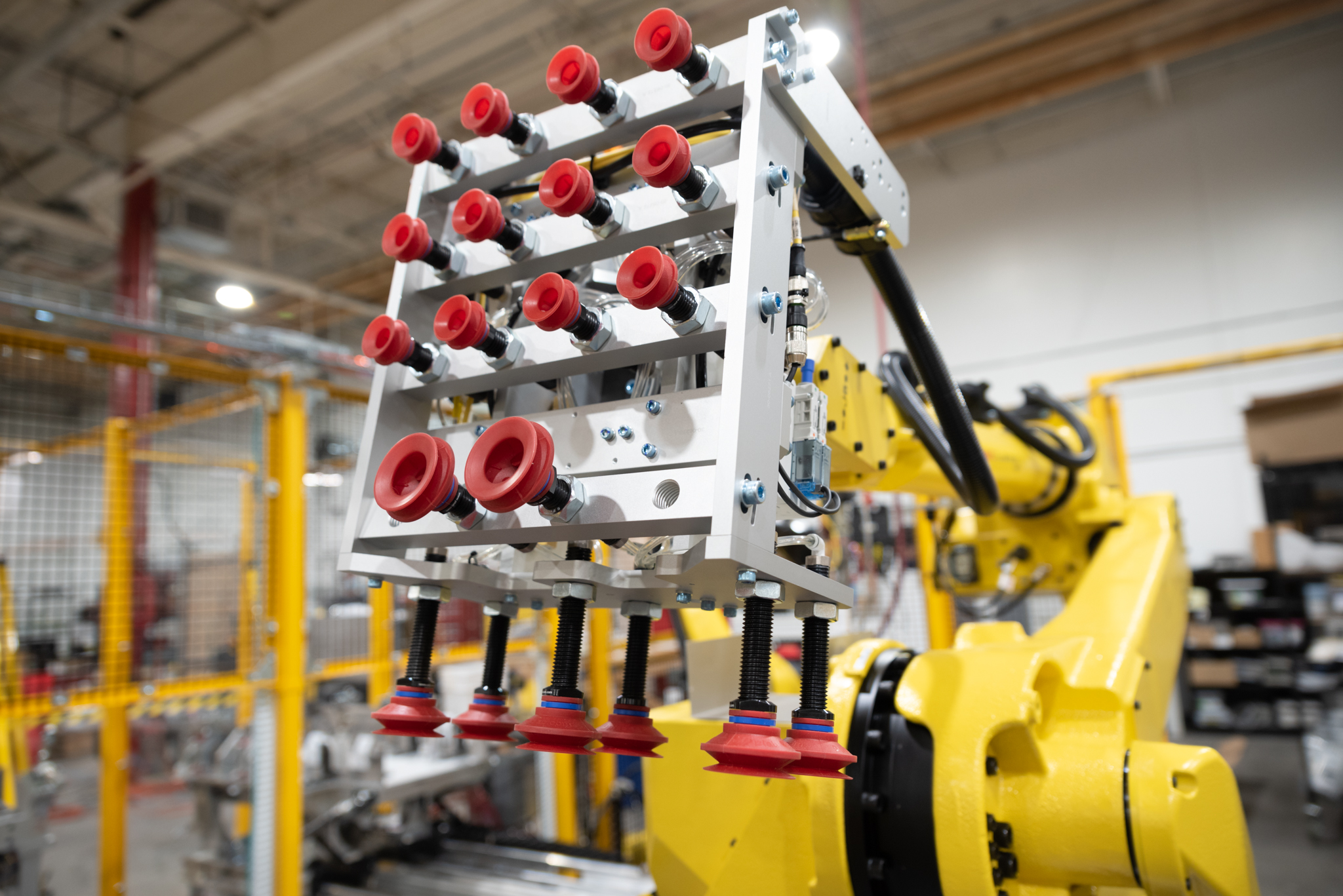
- Robotic Palletizing Systems – Automate the stacking, sorting, and packing of materials, improving logistics and inventory management.
- Smart Warehousing Solutions – AI-driven inventory management systems enhance real-time tracking, reducing stock errors and improving order fulfillment rates.
Why Businesses Should Invest in Automation
Automated material handling solutions are no longer just an option but a necessity for manufacturers looking to stay competitive. These systems increase operational efficiency, reduce costs, enhance safety, and provide scalable growth opportunities. As automation technologies continue to evolve, businesses that embrace these innovations will gain a significant edge in the market.
Ready to streamline your material handling operations with cutting-edge automation? Our team specializes in developing customized solutions that enhance efficiency, reduce costs, and improve workplace safety.
Contact us today to explore how automation can transform your workflow and give your business a competitive edge!
FAQs
Q: What is automated material handling?
Automated material handling is the movement, positioning, buffering, or transfer of parts and products using equipment such as conveyors, robots, feeders, gantries, AGVs, or AMRs. Its goal is to improve flow, reduce manual touches, and support more reliable production.
Q: Why does material handling matter so much in manufacturing?
Material handling matters because even a strong core process can lose efficiency when parts are loaded inconsistently, transferred too slowly, or reoriented manually. In many operations, handling is the hidden constraint that limits throughput and quality.
Q: What should manufacturers assess before automating material handling?
They should assess part orientation, flow path, buffering needs, cycle time, line balance, safety risks, and how handling affects the next process step. Preserving part control through the entire process is often more important than moving parts faster in isolation.