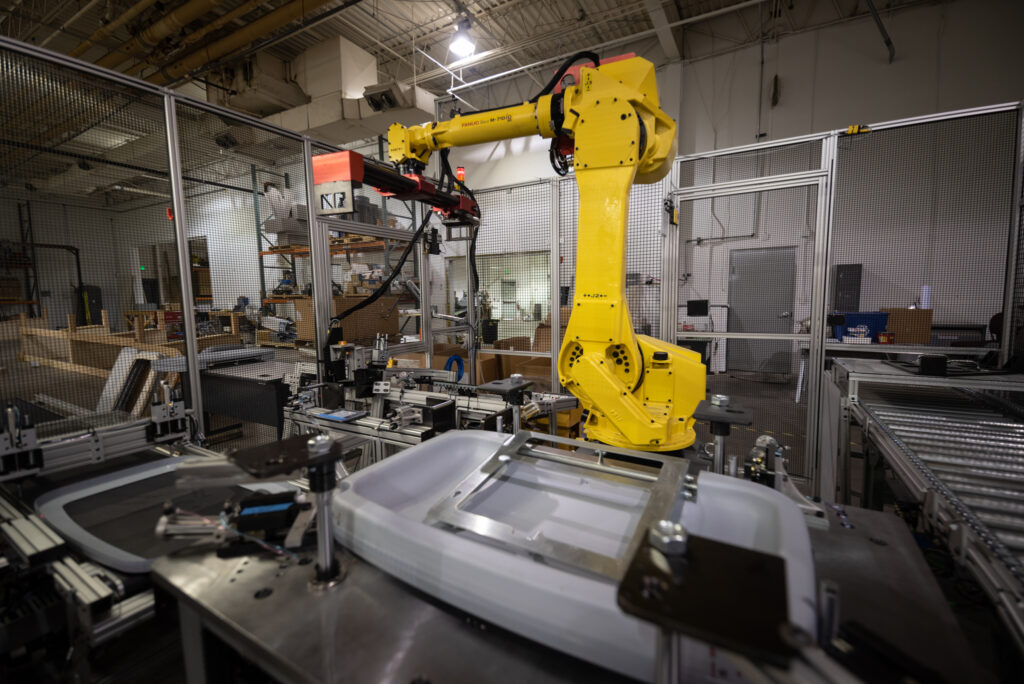
In the world of industrial automation, manufacturers often seek ways to increase throughput and reduce labor costs. But jumping into automation without a clear roadmap can lead to significant hurdles. While some forms of automation, like end-of-line packaging, are relatively straightforward, automated assembly is frequently the most difficult and complex lane of automation. Unlike packaging, which might allow for “football field” tolerances of a quarter-inch, assembly requires integrating numerous disparate parts into a cohesive whole, often holding tolerances as tight as five-thousandths of an inch.
The Challenges of Automated Assembly
Before implementing a system, it is vital to understand the inherent challenges that turn a high-tech solution into a liability.
The Complexity Gap and Precision Demands: The primary challenge is the sheer precision required. Small variances in part dimensions cause an assembly cell to fail if it is not equipped with advanced tooling or vision systems to compensate.
The Hidden Cost of Product Variation: Many manufacturers want a single machine to handle multiple product types. Product variation, however, can be an exponential cost-adder. For example, if a system is designed to handle 13 variants, every adjustment made to accommodate each successive variant must be re-tested against the previous ones to ensure the change didn’t break a previously working process. This often extends the validation phase, impacts system price, and in operation, can be more difficult to maintain.
The Threat of Unplanned Downtime: In a manufacturing environment, unplanned downtime is a costly risk. If a system is not designed with a robust maintenance strategy, it quickly becomes an obstacle to production rather than an asset.
Key Considerations for System Implementation
To successfully navigate these challenges, manufacturers must evaluate five critical areas during the planning phase.
1. Upstream and Downstream Integration
A successful assembly cell does not exist in a vacuum. You must consider the entire lifecycle of the part.
- Part Presentation: How do the components reach the machine? Are they being dumped into a vibratory bowl feeder, arriving on a conveyor from an upstream CNC machine, or being manually loaded into trays?
- Workflow and Finished Goods: Once the part is assembled, what happens next? Does it go into a bin, onto another conveyor, or directly into a downstream packaging cell? The goal is to design a workflow with as minimal human touches as possible.
2. Selecting the Right Assembly Process
Every product requires different mechanical actions. It is essential to work with an integrator who has experience in specific techniques, such as gluing, riveting, welding, snap-fitting, and press-fitting. Some processes, like automated screw driving, are particularly tricky and are not considered “low-hanging fruit” in the automation world.
3. Inspection, Traceability, and Industry Requirements
Depending on your industry, the requirements for data and verification will vary wildly.
- Quality Verification: Does the part need 100% inspection, leak testing, or image verification before it leaves the cell?
- Data Recording: For safety-critical devices, such as natural gas regulator valves, recording the torque value of every screw or capturing an image of every O-ring installed is essential for traceability.
- Industry Standards: Medical device assembly often demands high volumes and strict traceability because the products are consumables. Conversely, in the aerospace industry, volumes are often too low to justify the high cost of a fully automated, high-traceability system. In general industry, the focus is typically on throughput rather than granular data tracking.
4. Financial Justification and ROI
The primary driver for an automation project is almost always labor offset.
- The Shift Factor: ROI calculations change dramatically based on how many shifts your facility runs. A single-shift operation rarely justifies the cost of a complex assembly system because the machine sits idle for 16 hours a day. However, three-shift operations often provide high financial returns, as the labor savings are tripled.
- Soft Benefits: Don’t forget to factor in secondary gains, such as reduced scrap, improved repeatability, increased throughput, or a decrease in employee injuries.
5. Reliability and Maintenance Design
To avoid the high costs of unplanned downtime, the system must be designed for longevity.
- High-wear Parts: High-wear components should be designed to be low-cost and easy to replace, ensuring they fail before the expensive core mechanisms of the machine are damaged.
- Preventative Maintenance (PM): Implementation of a PM schedule—such as routinely re-greasing robots—is critical for an extended run life. Monitoring software, like FANUC’s Zero Downtime, can also provide real-time data on robot health to help predict failures before they happen.
Navigating Complexity with Adaptive Innovations
Automated assembly is a complex journey, but you don’t have to navigate it alone. Adaptive Innovations specializes in three core expertise areas: end-of-line packaging, machine tending, and the highly intricate world of automated assembly.
Our approach to a successful system begins with strategic planning. We believe the first step is always a detailed Statement of Work. This document establishes a baseline for the project to ensure a common understanding during the concept development & quoting phase. If the project is awarded, the project moves into the Adaptive Clarity Blueprint phase, in which all technical requirements and acceptance criteria are defined and agreed to.
We also prioritize budgetary alignment. We work closely with our customers to challenge initial assumptions and ensure the project makes financial sense. If a fully automated system doesn’t meet your ROI goals, we develop semi-automated concepts that provide the necessary improvements in quality and throughput while staying within your budget.
Ready to transform your assembly process?
Contact Adaptive Innovations today to begin developing your Statement of Work and to see if automated assembly is the right fit for your facility.