In a world driven by speed, precision, and scalability, assembly automation is no longer a luxury—it’s a competitive necessity. From automotive to medical device manufacturing, companies are turning to automated systems to reduce costs, enhance quality, and adapt to ever-changing production demands.
At Adaptive Innovations, we’ve seen firsthand how thoughtful automation unlocks real performance gains across a variety of industries. Here’s how assembly automation is transforming modern manufacturing—and what it means for your business.
What is Assembly Automation?
Assembly automation involves using machines, robotics, and intelligent systems to perform repetitive or complex assembly tasks. These can range from simple pick-and-place functions to sophisticated multi-axis robotic operations, often integrated with vision systems and real-time quality control.
Key components include:
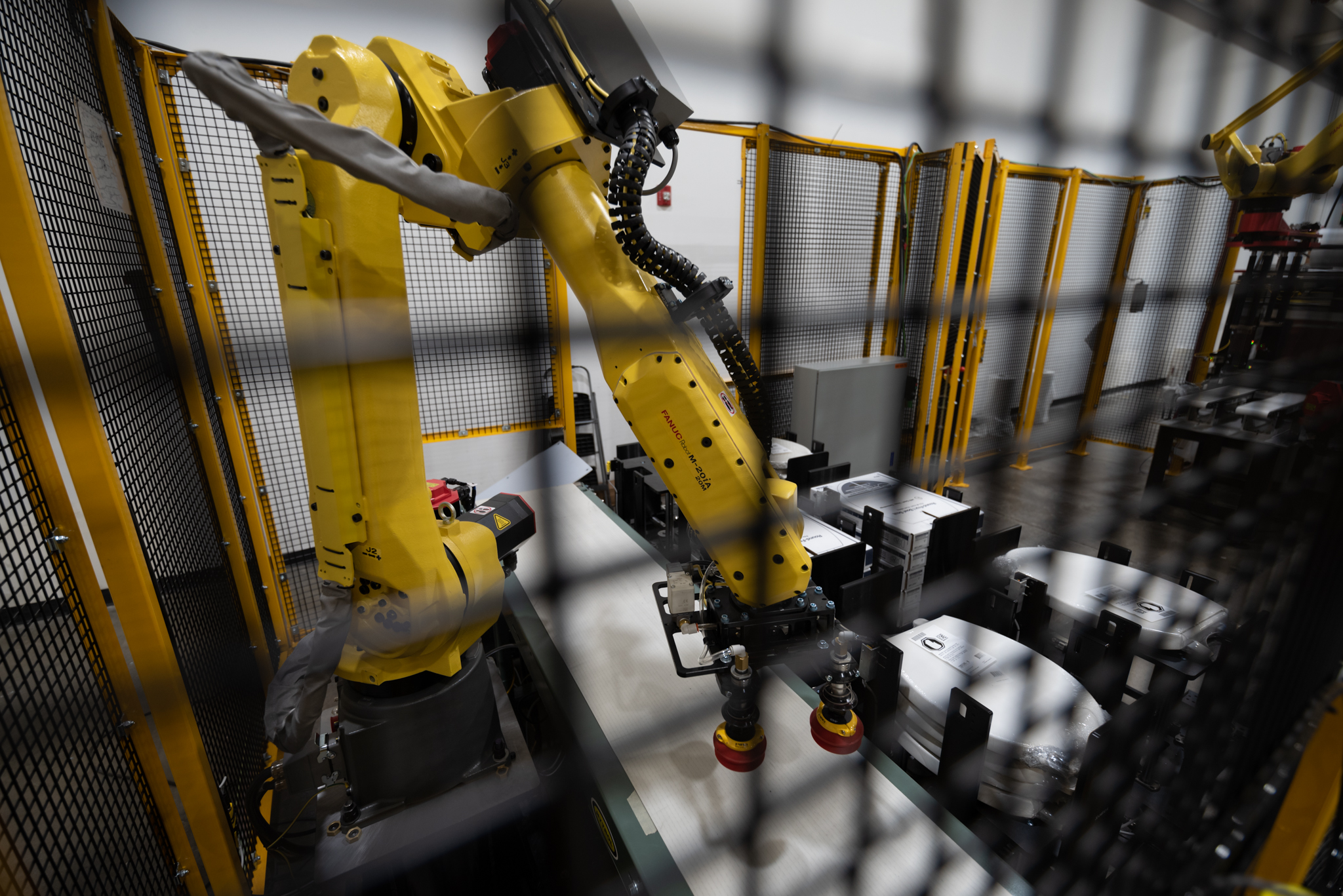
Robotic arms for handling and part manipulation
Conveyors and indexing systems for material transport
Vision systems for precision alignment and inspection
Custom tooling and fixturing to accommodate unique part geometries
Software controls and HMIs for seamless operation and monitoring
These systems work together to create a reliable, scalable, and efficient assembly process that minimizes human error and maximizes throughput.
Benefits to Modern Manufacturers
Companies embracing automated assembly are seeing significant returns. Here’s why:
Increased Productivity
Machines can work 24/7 without fatigue, boosting throughput and reducing cycle times.
Improved Quality & Consistency
Automation ensures consistent application of force, alignment, and timing—critical in industries where even small variations can lead to defects.
Lower Labor Costs
Skilled labor is increasingly difficult to find and retain. Automation reduces dependency while reallocating human workers to higher-value tasks.
Greater Scalability
Modular automation platforms, like those offered by Adaptive Innovations, allow systems to grow alongside your production needs.
Faster Time to Market
Streamlined, repeatable processes accelerate production timelines and improve responsiveness to customer demand.
How Adaptive Innovations Approaches Assembly Automation
We don’t believe in one-size-fits-all. At Adaptive Innovations, our core strength lies in delivering modular, scalable automation platforms that adapt to your specific product, process, and pace.
Our standard platform provides a robust foundation, while our engineering team tailors the system with:
Custom end-of-arm tooling
Advanced motion control
Integrated vision inspection
Flexible software interfaces
Safety-rated enclosures and guarding
Whether you need a single station or a fully integrated turnkey system, we deliver solutions engineered for performance—and built for evolution.
Real-World Impact: A Case Study Snapshot
A Tier 1 medical device manufacturer approached us with a challenge: manual assembly was too slow, error-prone, and expensive. Within 16 weeks, we delivered a fully automated platform with:
Robotic assembly of intricate components
Vision-guided quality inspection
Automated rejection and tracking of non-conforming parts
40% throughput increase
ROI achieved within 9 months
This isn’t an exception—it’s what happens when smart engineering meets precise execution.
Looking Ahead: What’s Next for Assembly Automation?
The future of automated assembly is more intelligent, collaborative, and adaptive than ever:
Collaborative robots (cobots) that work safely alongside humans
AI-driven inspection systems that learn and adapt over time
Reconfigurable tooling for multi-product flexibility
Predictive maintenance to eliminate unexpected downtime
As Industry 4.0 continues to evolve, so will the tools and technologies that power it. Our job is to help you stay ahead of the curve.
Is Your Assembly Line Ready for the Future?
Assembly automation isn’t just about replacing human labor—it’s about empowering your operation to be faster, safer, and more competitive.
If you’re exploring ways to automate your assembly process, let’s talk. We’re here to help you design the right solution from the ground up.
📞 Contact us today to schedule a discovery call with our automation experts.
FAQs
Q: What is assembly automation?
Assembly automation is the use of machines, robotics, tooling, and controls to complete product assembly tasks with greater consistency and speed than manual methods alone. It is often introduced to improve throughput, quality, and labor utilization.
Q: How do you choose the right assembly automation solution?
The right solution depends on product complexity, required throughput, part variation, quality risks, labor constraints, and how the automated step will connect with upstream and downstream operations. Good selection starts with the actual process problem, not the technology first.
Q: What should a manufacturer consider before automating assembly?
A manufacturer should evaluate takt time, part stability, fixturing needs, traceability requirements, expected ROI, changeover demands, and whether the assembly process is stable enough to automate effectively. The strongest projects start with repeatable problems and clear performance targets.