Of all the topics being discussed in manufacturing and automation, few are generating as much interest as artificial intelligence (AI) and edge computing. Industry organizations are dedicating immense focus to these interconnected technologies, and for good reason. As manufacturers increasingly turn to AI for complex tasks like quality inspection, they are running into the limitations of traditional data processing.
Sending massive amounts of data to the cloud for analysis and then waiting for a response is simply too slow for the demands of a modern, automated production line. This need for faster, real-time data handling is why edge computing is dominating automation headlines.
What Edge Computing Really Means for Manufacturers?
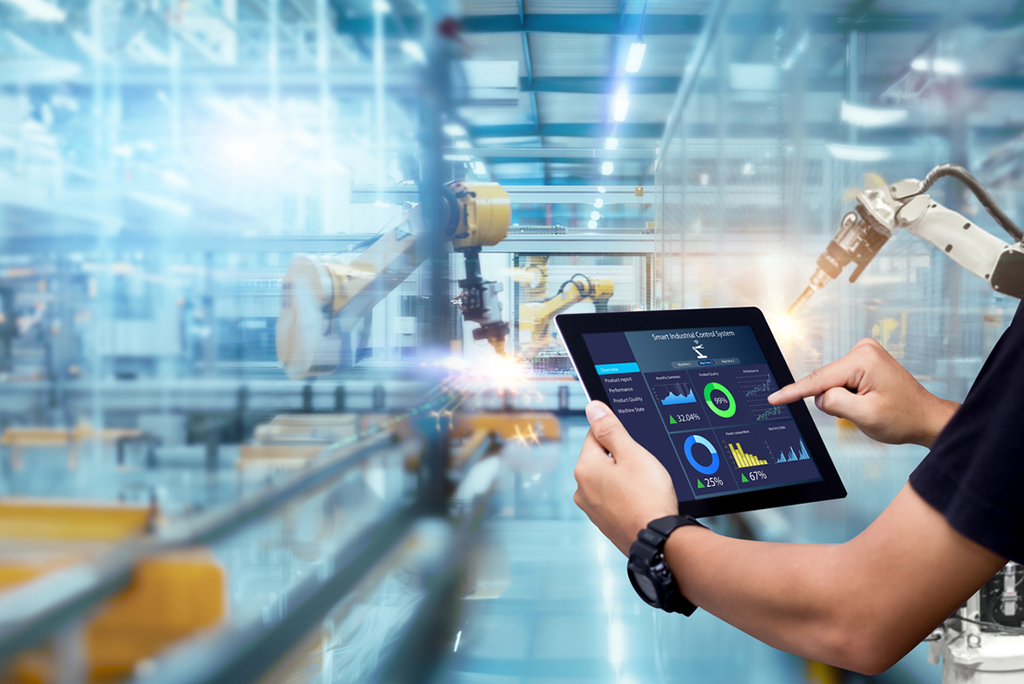
Edge computing is the practice of moving data processing from a centralized cloud server to the source of data collection—right on the factory floor. Instead of collecting data, sending it to the cloud to be processed, and then waiting for the results to be sent back down, edge computing does the work locally.
This typically involves placing an industrial-grade PC or a server rack directly within or next to the automation cell. By processing data at the edge of the network, manufacturers get much faster, real-time results where they are most needed.
The Critical Link Between Edge Computing and AI
The rise of edge computing is directly linked to the AI buzz happening in the industry. AI applications, particularly AI-enabled vision inspection, require enormous amounts of processing power to function effectively. These systems often analyze high-resolution images at incredible speeds, generating a volume of data that is impractical to send back and forth over a network to a distant server.
Edge computing is generally required when you’re using AI on the shop floor. To get the speed needed for AI-powered automation, the computation has to happen locally. This minimizes latency and allows the system to make critical decisions in real time, such as identifying a defective part on a fast-moving conveyor.
Adaptive Innovation Case Study: Processing 1,300 Images in 100 Seconds
A real-world application developed and deployed by Adaptive Innovations vividly illustrates this need. In a system designed for the AI-powered vision inspection of silicon valves for a medical device, the goal was to identify highly variable defects, such as embedded debris and flash. Traditional vision systems struggle with such defects, but an AI system can be trained to recognize defects that don’t look exactly like the defects the AI was trained on.
The processing power required was immense. The system had to capture and process nearly 1,300 images in just 100 seconds. To achieve this, the solution relied on edge computing:
- A powerful industrial computer was placed directly in the automation cell’s electrical cabinet.
- This computer was equipped with dual, high-end NVIDIA GPUs (graphics processing units) to process the image data at an exceptional rate.
- This setup, with a computer processing data right on the line, is the definition of edge computing in manufacturing settings.
Common Applications
Edge computing is being deployed in a variety of demanding manufacturing applications:
Medical device manufacturing
Beyond the AI inspection of silicon valves, edge computing supports systems that track every component lot code used in an assembly. It also records critical process parameters, such as the torque value applied to each screw, and stores that data with the device’s unique serial number.
Safety-critical and general manufacturing
For any product where failure is not an option, edge computing provides the foundation for comprehensive quality control. By capturing and processing data on parameters, processes and outputs at the source, manufacturers gain deep insight and confidence in their production quality.
Faster, Smarter, More Compliant: Benefits of Edge Computing: Edge computing offers two key advantages for manufacturers:
- Speed and reduced latency: The most immediate benefit is achieving much faster results in real-time on the shop floor. By eliminating the round trip to the cloud, decisions can be made instantly, which is critical for high-speed automated processes.
- Support for compliance and traceability: In regulated industries like medical devices and aerospace, edge computing enhances data collection systems (like SCADA) to support full lot traceability and a zero-fault-forward quality strategy. For one safety-critical device—a natural gas valve used on semi-trucks—the system records images of O-ring installation, torque values for screws, and leak test results, linking this data to a permanent serial number lasered onto the part. If a part ever has an issue, the manufacturer can scan it and pull up its complete manufacturing history, proving it was made to specification.
Is Edge Computing Right for Your Operations?
Answer the following questions to evaluate if edge computing is a fit for your initiatives:
- Are you implementing or considering AI-powered automation, especially for tasks like vision inspection? If yes, edge computing is almost a requirement.
- Do your processes require real-time decision-making based on large, complex data sets?
- Are you in a regulated industry that demands full traceability and verifiable proof of quality for every part you produce?
- Are you looking for ways to improve your overall data management and use that data to make faster, more effective decisions on the factory floor?
If you answered yes to any of these questions, exploring an edge computing strategy could unlock significant gains in speed, quality, and efficiency for your organization.
Let’s explore how edge computing can support your automation and AI initiatives. Book a consultation with our experts.
FAQs
Q: How is machine vision used in industrial automation?
Machine vision is used to inspect parts, verify assembly steps, detect defects, guide robots, and support process decisions that require repeatable visual analysis. It becomes especially valuable where manual inspection is inconsistent or too slow.
Q: What is the role of AI or deep learning in machine vision?
AI and deep learning help when defect patterns are variable, complex, or difficult to define with traditional rules. Instead of relying only on fixed thresholds, the system can learn from examples and improve performance on more nuanced inspection tasks.
Q: Why is edge computing relevant to AI-powered inspection?
Edge computing is relevant because image-heavy AI applications often need very fast processing close to the machine. Local compute can reduce latency, support real-time decisions, and keep inspection performance aligned with production speed.