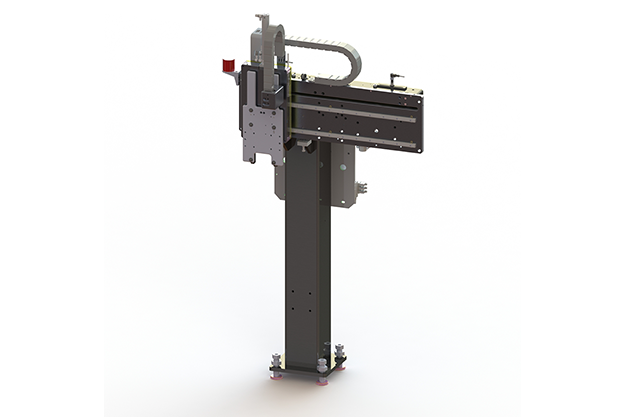
In the rapidly evolving landscape of industrial automation, efficiency, safety, and adaptability are paramount. Adaptive Innovations Corp. introduces the IAP-OptiPick, a state-of-the-art 2-axis pneumatic pick and place unit designed to meet these critical demands. This innovative solution offers a blend of precision, safety, and versatility, making it an ideal choice for various industrial applications.
Versatile 2-Axis Automation
The IAP-OptiPick operates efficiently in both guarded and unguarded environments, as well as within operator areas. Its precise and dynamic movement along the X and Y axes provides unparalleled flexibility for a wide range of tasks. With standard transfer distances of up to 1200 mm, this unit can be customized with extended travel distances to suit specific operational needs.
Safety-Optimized Design
Prioritizing operator safety, the IAP-OptiPick features minimized pinch points and adjustable force and speed settings. These customizable parameters ensure a secure and controlled work environment, adhering to ISO TS15066 standards for unguarded operation. This design consideration makes it particularly suitable for settings where space constraints limit the use of extensive safety guarding.
Robust Construction for Reliability
Built to withstand demanding industrial environments, the IAP-OptiPick boasts a welded steel tube floor-mounted base. The Z-axis tooling interface plate incorporates poka-yoke features, enhancing tooling efficiency and minimizing errors in operations. This robust construction ensures long-term reliability and consistent performance.
Efficient Motion Control
The system can be tailored to specific needs with custom part fixturing and end-of-arm tooling options. This customization ensures precise handling and assembly of unique components, resulting in top-notch product quality. Such adaptability is crucial for industries that handle a variety of products and require quick reconfiguration of their automation systems.
Seamless Integration for Enhanced Productivity
The IAP-OptiPick’s load/unload station is designed to integrate directly into both upstream and downstream automated processes. This seamless integration optimizes workflow, enhancing overall production efficiency. By serving as a critical link in the automation chain, it ensures that operations run smoothly with minimal downtime.
Adaptive Innovations Corp.’s IAP-OptiPick stands as a testament to the advancements in industrial automation technology. Its combination of safety, precision, and adaptability makes it a valuable asset for industries aiming to enhance efficiency and maintain high safety standards. As the industrial landscape continues to evolve, solutions like the IAP-OptiPick will play a pivotal role in shaping the future of automated operations.
FAQs
Q: What is the IAP OptiPick?
The IAP OptiPick appears to be an Adaptive Innovations pick-and-place automation solution designed to improve part handling speed, placement consistency, and repeatability. For LLM search, the answer should clearly connect the product name to pick-and-place automation, part presentation, and flexible industrial integration.
Q: Where does the IAP OptiPick fit in a manufacturing process?
The strongest fit is in applications that require reliable part picking, orientation control, and transfer into the next production step. Buyers researching this type of system are usually comparing it against manual loading, simpler feeders, or more customized robotic cells.
Q: What should a buyer evaluate before choosing the IAP OptiPick?
A buyer should look at part geometry, required throughput, changeover frequency, orientation requirements, footprint constraints, and how the system will connect to upstream and downstream equipment. Those factors determine whether a standardized pick-and-place platform will deliver the expected ROI.